
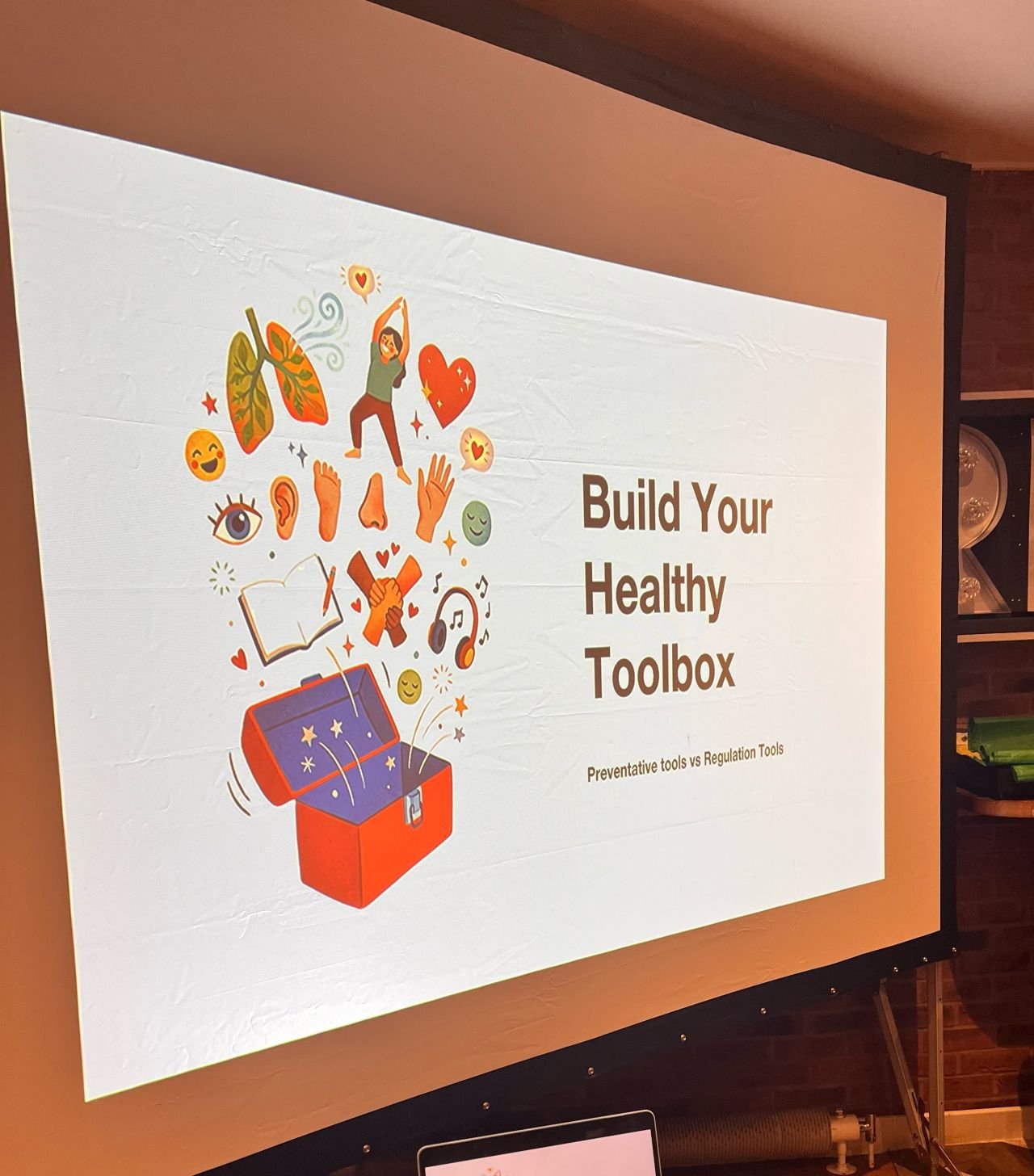
In November, I delivered two sessions of my workplace wellbeing workshop, Build Your Healthy Toolbox: Realistic Tools for Managing Everyday Pressure, to over 20 staff members at Wolverhampton Grand Theatre. Designed to bridge the gap between general mental health awareness and empowering people in self-regulation, the sessions achieved a 100% recommendation rate, a 30.5% uplift in emotional pressure handling, and a 31.3% increase in mind-body stress awareness.
Most workplaces today are much better at talking about mental health than they used to be. Yet there is still a massive gap between general awareness and providing people with tools to empower themselves in self-regulation. Knowing that stress is bad for us does not automatically stop our heart from racing, our shoulders from tensing, or our thoughts from spiralling when pressure builds. It is easy to get caught up in the rush of what needs doing next and miss the signals our own body is sending us.
Realistic Tools Over Quick Fixes
Working in a busy theatre environment brings unique demands, fast turnarounds, and high-pressure moments. Rather than asking the team to somehow eliminate workplace pressure, this employee resilience training focused on helping individuals spot their early physical signs of stress and regulate themselves in the moment.
Stress is a normal part of life, and we cannot always control the curveballs that come our way. What we can change is how we notice what is happening inside us and how we respond before it takes over.
During our time together on the 2nd and 9th of November 2026, we focused on three simple things:
Understanding the mind-body connection, looking at how racing thoughts and physical tension feed into each other, and noticing where an unhelpful emotional loop starts so we can interrupt it.
Turning everyday habits into reset tools, finding practical, realistic ways to weave nervous system regulation into daily routines that already exist, whether at work or outside of work.
Regulating in the moment, giving the team simple stress management techniques they can use discreetly when unexpected challenges or difficult situations arise.
What Changed in the Room
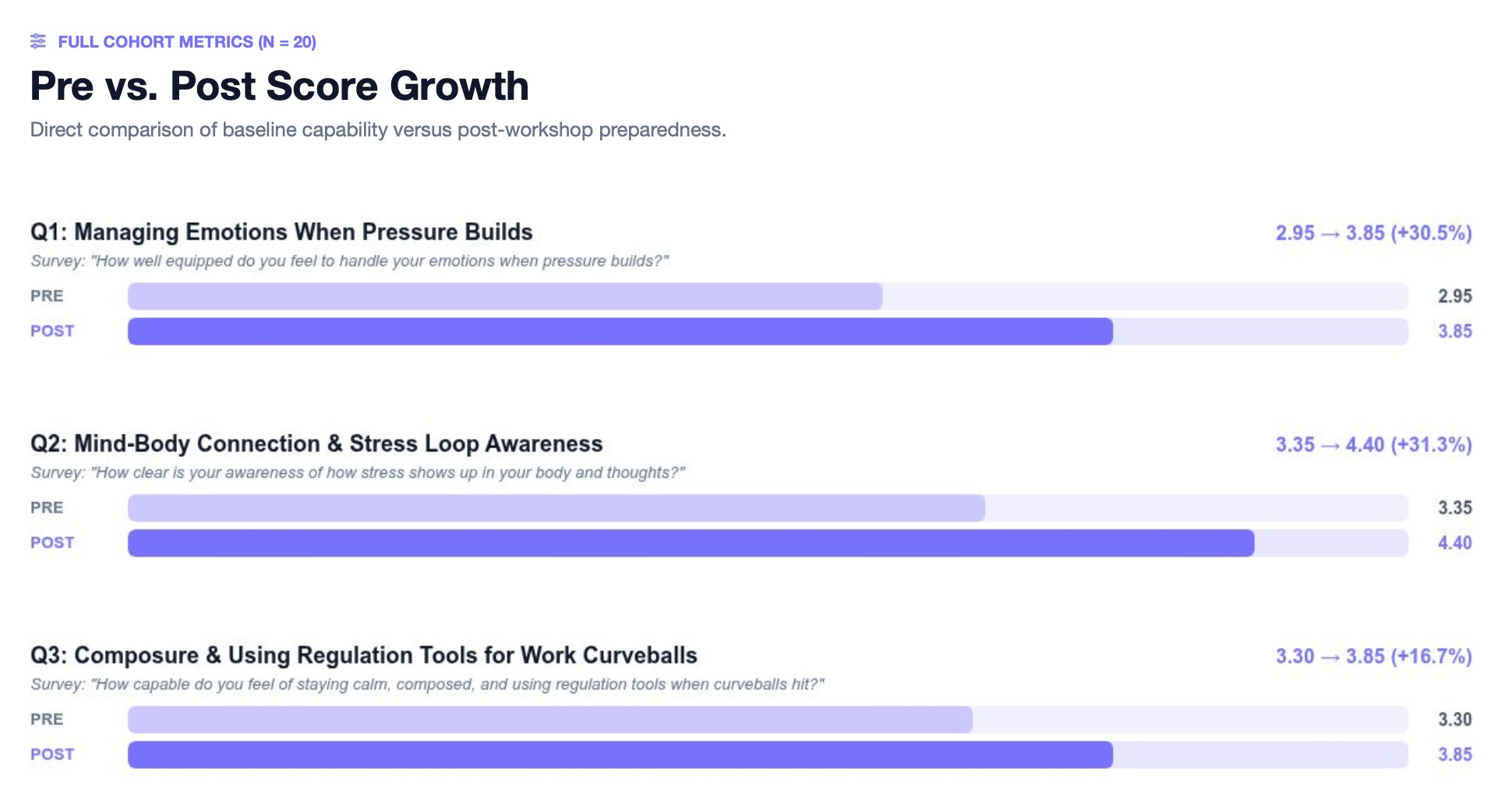
To make sure the sessions actually landed rather than just feeling like an hour away from the desk, we ran pre- and post-workshop evaluations across all 20 participants. Looking at the numbers afterwards really confirmed how much people need practical, human tools right now:
100% positive recommendation, with every single attendee recommending the session and giving an average score of 4.65 out of 5.
+30.5% uplift in handling emotional pressure, with confidence in managing emotions when pressure builds rising from 2.95 to 3.85 out of 5, and 85% of participants feeling noticeably more equipped.
+31.3% increase in mind-body awareness, with clarity around how stress physically shows up in the body and thoughts climbing from 3.35 to 4.40 out of 5.
+16.7% growth in handling work curveballs, as staff reported feeling more capable of staying calm, composed, and using regulation tools when unexpected challenges hit.
What the Team Shared
The numbers are great to see, especially when making the case for workplace wellbeing, but reading the written feedback from the people in the room is what really stays with me. Here is what some of the team shared after the sessions:
"It was nice to understand the loop & where to stop & think :)"
"Amazing session, really helps my mindfulness & daily life. Great thanks! I will remember that!"
"Interesting, & good to understand others experience similar issues."
"Although some of these techniques might be difficult to use in a meeting, as a way to build behaviours & change responses that was really helpful."
"Thank you for all your time and effort. I hope you're able to reach and help many more people!"
Building Resilience That Lasts
One of the clearest things that came through in the feedback was that people want more than a one-off conversation. Several attendees mentioned wanting more time to practise the tools, regular follow-up sessions to build lasting habits, and a quiet, screen-free space to step away and reset during the workday.
It is just like anything else we want to change in life. One session is a great starting point, and it opens the door to understanding ourselves a bit better, but real workplace resilience comes from consistency and having the space to practise when things are calm so the tools are there when life gets loud.
Want to Support Your Team's Resilience?
If you are an HR manager, people lead, wellbeing champion, or workplace experience manager looking for practical workplace wellbeing workshops that give your team realistic tools they can actually use in the middle of a busy day, I would love to have a chat.
Whether you are looking for an introductory one-hour workshop or a regular schedule of practical sessions and guided rest, we can shape something that fits your team and how they really work.
Book a free discovery call with me today to talk through what your team needs and how we can bring Build Your Healthy Toolbox into your workplace.
Frequently Asked Questions
What is the Build Your Healthy Toolbox workplace workshop?
It is a practical, one-hour employee resilience workshop designed to help staff understand the mind-body connection, spot early physical signs of stress, and use simple nervous system regulation tools during the workday.
How do you measure the impact of workplace wellbeing sessions?
Every workshop includes paired pre- and post-session evaluations measuring shifts in emotional regulation, mind-body stress awareness, and confidence in handling unexpected workplace curveballs.
Can sessions be tailored for different teams or office environments?
Yes. Sessions can be delivered as a standalone one-hour introduction or structured into a regular schedule of practical workshops and guided rest sessions tailored to your team's working day.
